martes, 14 de mayo de 2019

Sean Scully at the National Gallery of Ireland

© National Gallery of IrelandCREDIT

9 May – 20 September 2015
Millennium Wing, Rooms 1-5 | Admission free
This exhibition marked the artist’s 70th birthday. Born in Dublin, Scully, now living and working in New York, retains a powerful sense of Irish identity. He moved to New York at the end of the 1970s and established himself as one of the leading abstract painters of his time. 
Responding to minimal art of the 1960s and 1970s, Scully has always striven to associate emotions and phenomena of the world into his art, resisting formalism while rigorously reducing the means he employs – a reduced palette of colours and restricting himself to patterns of vertical and horizontal stripes. Scully has always managed to introduce extraordinary variety into his paintings, while their titles often hint at associations with his life or surroundings. 
This exhibition at the National Gallery of Ireland charted his work in the 1980s and 1990s, and juxtaposed paintings from that period with works, principally multi-part photographic sequences, made over the past decade. The exhibition brought together a group of major paintings on loan from Tate, Arts Council England, Irish Museum of Modern Art, Kerlin Gallery, as well as works on paper from a private collection. It also featured a single ‘window’ painting as a response to the earlier ‘White Window’, and a photographic work in ten parts. 
Curator: Sean Rainbird, Director, National Gallery of Ireland


domingo, 28 de abril de 2019

Nelly Richard: “El arte no borra el conflicto”


Nelly Richard: “El arte no borra el conflicto”

Comisaria y teórica cultural, ha construido uno de los discursos más sólidos y mejor articulados en torno a la memoria en Chile


Nelly Richard en el patio del Museo Reina Sofía de Madrid
Nelly Richard en el patio del Museo Reina Sofía de Madrid VÍCTOR SAÍNZ

La historia y la crítica del arte, la estética, la filosofía y la teoría feminista se entrecruzan en el trabajo de Nelly Richard (Caen, Francia, 1948). Formada en la Sorbona, la carrera de esta comisaria, académica y teórica cultural se ha desarrollado en Chile desde 1970, donde ha indagado en el papel y potencial del arte bajo la dictadura de Pinochet y tras la caída del régimen. Richard ha construido uno de los discursos más sólidos y mejor articulados en torno al arte, la política y la memoria en libros como Fracturas de la memoria. Arte y pensamiento crítico (2007) y Campos cruzados. Crítica cultural, latinoamericanismo y saberes al borde (2009), y fundó la hoy desaparecida Revista de Crítica Cultural.
En el Museo Reina Sofía de Madrid, a finales de marzo, Richard impartió el seminario Chile: las operaciones críticas de la memoria, que acompañó de la muestra —abierta hasta finales de mayo— Tiempos incompletos (Chile, primer laboratorio neoliberal), en la que enfrenta dos piezas actuales de los artistas Patrick Hamilton y Felipe Rivas San Martín con documentos de la revuelta feminista estudiantil de 2018. La cuestión para esta teórica es “cómo sacudir el repertorio de la memoria con estrategias creativas. No se trata del dilema entre olvidar o recordar, la pregunta, desde la crítica, es qué recordar y cómo hacerlo”, explicaba a los alumnos del seminario, antes de apuntar que ni siquiera la iconografía poderosa y conmovedora de las imágenes en blanco y negro de los desaparecidos está a salvo —como no lo está ningún recuerdo— del desgaste por repetición. El recuerdo muta fácilmente en souvenir y el reto es revertir esto, “desacostumbrar la mirada”. Al día siguiente, Richard vuelve a hilar con rapidez ideas y conceptos, frente a un agua con gas en la cafetería del museo.
Habla usted sobre la pasividad e indiferencia que generan los lenguajes del neoliberalismo. ¿En qué consisten estos lenguajes?
El neoliberalismo es una doctrina económica y una técnica de gobierno que produce saberes funcionales que se ajustan a las dinámicas del mercado. El paisaje del conocimiento pasa a ser tecnificado y deja pocos recursos para el arte y la estética. La sociedad de consumo y el capitalismo hiperintensivo domestican la subjetividad y presentan sus imaginarios a través de distintos medios y recursos, con un desfile incesante de imágenes que generan una visualidad liviana, sin gravedad, dejando muy poco espacio para la crítica.
Si todo pierde peso y se banaliza, ¿qué papel tiene el arte?
Es un desafío para el arte crítico, especialmente cuando se ocupa de la memoria y de trabajar el recuerdo. Cada práctica creativa diseña su propia estrategia para cuestionar esos modelos sociales, esa imagen enteramente satisfecha.
¿Se impone el regreso al arte político?
Hay que ir con cuidado aquí y distinguir entre el arte político de la representación y lo político en el arte. El arte de reclamo, la legitimidad moral del compromiso con una causa o la denuncia no bastan.
¿De ahí parte la diferencia entre el arte político y el crítico?
El crítico es una emancipación de la subjetividad que invita al espectador a tomar un papel activo en la reelaboración del mensaje de la obra y a cuestionar la hegemonía cultural. Se sitúa en un lugar distinto del arte político de las buenas intenciones, o dependiente de un mensaje ideológico. Hay un arte que pugna por reintroducir en el discurso normalizador de la transición los residuos de la memoria.
¿Qué problemas plantea la iconografía del recuerdo?
En la posdictadura en Chile surgieron sitios de la memoria, homenajes a los detenidos-desaparecidos que son importantes por su dimensión ritual, dado que el neoliberalismo lo quiere borrar todo. Pero en el arte no basta con poner en escena imágenes del pasado, hay que lograr que el pasado dialogue con el presente y produzca alguna conmoción. No basta con conmemorar, hay que volver a dotar de energía al recuerdo, entablar una conversación con un presente disconforme. El boom de la memoria de 2004 permitió en Chile transmitir una conciencia, dejar claro que eso que se dice que ocurrió, sí pasó. Parecía que la batalla se había ganado, pero todo puede ser revertido.
¿Es el campo cultural un camino para la reconciliación o el encuentro?
La palabra reconciliación me genera dudas porque implica ese no seguir dándole vueltas al pasado. Y el arte tampoco es espacio de encuentro, no borra el conflicto. Sí puede hacer una reparación simbólica, por su dimensión metafórica, haciendo visibles o restituyendo la validez de problemáticas sumergidas en el olvido o en la insignificancia.
En un mundo en el que el arte está tan cotizado como mercancía, ¿qué papel debe desempeñar la crítica?
El canon modernista de la crítica hace tiempo que se fracturó. El mercado dicta los gustos y las preferencias. Pero no hay que pensar en la academia como método sino como una dimensión que atraviesa la práctica, las obras. La crítica está llamada a cuestionar el sentido común, la idea de que las formas hablan por sí mismas. Y la interpretación de los signos hoy sigue siendo fundamental, porque no son algo transparente sino campos de disputa en los que chocan distintas visiones del mundo. El ejercicio crítico problematiza lo que el mercado simplifica. Se trata de descifrar esa fuerza y enseñar a tomar partido, de luchar contra el consumo acrítico, y activar otras lecturas.


David Douard


jueves, 18 de abril de 2019

Lisa Rosendahl Appointed Curator of GIBCA 2019 and GIBCA 2021

700x500-lisa1.jpg


September 7- November 17, 2019

For the 10th edition in 2019, Göteborg International Biennial for Contemporary Art (GIBCA) will re-consider its format and extend beyond its implied temporality by inviting a curator to work with the two coming editions. GIBCA aims to offer artists a platform for long-term engagement with the local context and invites residents to foster and discover compelling artistic presentations.

Göteborg International Biennial for Contemporary Art (GIBCA) is delighted to announce the appointment of Lisa Rosendahl as curator of its editions in 2019 and 2021.

- We are extremely happy that Lisa has accepted our invitation to curate two editions of GIBCA and shape this open-end project together with us. Throughout her curatorial practice, she has shown impressive determination to follow a thematic extendedly, devotion to the artistic processes, and interest in redefining art presentation formats. With strong knowledge of the Nordic art scene and an informed international perspective, Lisa’s work as a curator is characterized by a context specific approach. Her recent projects have focused on the industrial past and present of Sweden, exploring the history of Modernity in the region with a number of Swedish and international artists. For GIBCA, a biennial located in an industrial and port city, this collaboration brings an opportunity to reflect more closely on the local context, says Ioana Leca, Artistic Director of GIBCA.
- Lisa also shares connections with Röda Sten Konsthall, the independent organisation behind GIBCA. Between 2006-2008 Lisa was part of a curatorial group that contributed to shaping the artistic direction of our art centre. Now, after ten years focusing on internationalisation for both the konsthall and the biennial, we look forward to working together again. It is exciting to welcome Lisa back for this long-term collaboration and see where the next four years take us, says Mia Christersdotter Norman, Director of Röda Sten Konsthall, organiser of GIBCA.
Lisa Rosendahl (b. 1974, Malmö) is an independent curator and writer based in Berlin.
As Curator at Public Art Agency Sweden from 2014-2017, Rosendahl initiated and curated the series Industrial Society in Transition commissioning context-specific works by artists such as Alexandra Pirici, Annika Eriksson, Raqs Media Collective, Sara Jordenö and Lisa Tan. Her curatorial research regarding the industrial past and present of Sweden includes also the exhibition The Society Machine – the Industrial Era from the Perspective of Art at Malmö Konstmuseum, 2016-2017. As Director of Iaspis, the Swedish Arts Grants Committee's international programme for visual art architecture and design, 2011-2013, she developed international collaborations and ran the Stockholm-based artist residency as well as an extensive programme of discursive events. Previous positions include Director of BAC, Visby, 2008-2010, Associate Curator at Röda Sten Konsthall in Gothenburg, 2006-2008, Director of Exhibitions at Lisson Gallery in London, 2003-2006, and Acting Director at Electra Productions in London, 2006-2007. As freelancer, she has curated exhibitions at a.o. Moderna Museet in Stockholm, Kunsthall Charlottenborg in Copenhagen and INIVA in London. She writes and lectures extensively on contemporary art and was a co-editor of Work, Work, Work – an Anthology of Art and Labour (Sternberg Press). Recently appointed Associate Professor of Exhibition Studies at Oslo Arts Academy, Rosendahl is currently curating the exhibition Rivers of Emotion, Bodies of Ore to open at Kunsthall Trondheim in September 2018.
GIBCA is a contemporary art project in Gothenburg, Sweden, that with every edition, raises stark questions that deal with the complexity of our contemporary world and presents a diversity of artistic positions. The editions of the Gothenburg biennial in 2019 and 2021 mark important milestones for celebration and assessment – the 10th edition of the contemporary art biennial, and the 400-year-anniversary of the City of Gothenburg, respectively. Autonomous in topicality and presentation, the coming biennials will seek to shape tools for sustained engagement in the local context and to better serve artistic processes.
The biennial functions in the interrelated fields of research, artistic creation, and philosophical thought and for each edition invites internationally practicing curators to enter in a dialogue with the city of Gothenburg, its citizens, people interested in art and artists around the globe.
GIBCA 2019 will run from September 7th to November 17th and will take place at Röda Sten Konsthall and collaborative arenas throughout the city of Gothenburg.
Previous editions of GIBCA have been curated by:
2017 Nav Haq
2015 Elvira Dyangani Ose
2013 Katerina Gregos, Claire Tancons, Joanna Warsza and Ragnar Kjartansson, in collaboration with Andjeas Ejiksson
2011 Sarat Maharaj with Co-Curators Gertrud Sandqvist, Dorothee Albrecht and Stina Edblom
2009 Celia Prado and Johan Pousette
2007 Edi Muka and Joa Ljungberg
2005 Sara Arrhenius
2003 Carl Michael von Hausswolf
2001 Ewa Brodin, Britt Ignell and Lasse Lindqvist
GIBCA is organized by Röda Sten Konsthall and has been initiated by the Cultural Committee of the City of Gothenburg.

Press enquiries:
Petra Landström
Communications Manager GIBCA and Röda Sten Konsthall
T: +46 (0) 31 12 08 46
Email: press@gibca.se

domingo, 14 de abril de 2019

ESTHER FERRER


esther ferrer
Esther Ferrer (Donostia / San Sebastián, 1937)
En 1963 forma el Taller de libre expresión en San Sebastián y más tarde la Escuela experimental de Elorrio, junto a José Antonio Sistiaga. En 1967 se une a ZAJ (creado en 1964 por Ramón Barce, Juan Hidalgo, Walter Marchetti) y realiza numerosas acciones, bajo el genérico de conciertos, hasta su disolución en 1996. A principios de la década de 1970 se establece en Paris, fecha en la que inicia colaboraciones periodísticas para medios como Egin, El país, Jano o Lápiz. A lo largo de los últimos 50 años ha desarrollado su obra en diferentes medios: dibujos, instalaciones, fotografía y, principalmente, acciones que han tenido al cuerpo como protagonista.
Pionera y una de las principales representantes del arte de la performance en el Estado español, ha realizado numerosas acciones en diferentes festivales, museos y centros de arte internacionales. Su obra ha sido expuesta en el Museo Nacional Centro de Arte Reina Sofía, Madrid; Centre National de la Danse, Paris; Museo Guggenheim, Bilbao; MAC/VAL, Frac Bretagne, Rennes; Artium, Vitoria; Museum for Samtidskunst, Roskilde; Koldo Mitxelena, Donostia-San Sebastián; Centro Andaluz de Arte Contemporáneo, Sevilla; Centre Pompidou, Paris; Fundació Antoni Tàpies, Barcelona; Círculo de Bellas Artes, Madrid; Museu Nacional de Belas Artes, Río de Janeiro; Fundació Joan Miró, Barcelona; La Centrale for Contemporary Art, Bruselas; MACBA-Museu d´Art Contemporani de Barcelona, Barcelona; entre otros.
En 1999, representó a  España en la Bienal de Venecia.
Ha recibido los siguientes premios: en 2006 el Trace-John Boehme Performance Art - Lifetime Achievement Award; en 2008 el Premio Nacional de Artes Plásticas; en 2012 el Premio Gure Artea; en 2014 el Premio  MAV-mujeres en las artes visuales y el Premio Velázquez de Artes Plásticas.

lunes, 8 de abril de 2019

The Biggest William Blake Exhibition In 20 Years Is Coming To London


Capaneus the Blasphemer
The largest William Blake exhibition in 20 years comes to London this autumn, celebrating the work of a singular artistic talent.
Known best for his poetry, including And did those feet in ancient time, and The Tyger, Blake was also a skilled and prolific artist.
Pity
Unfortunately, his ill-fated exhibition of 1809 held above his family's hosiery shop in Soho, meant he was never lauded by the public in his time.
This September, Tate Britain hopes to rectify this, by exhibiting over 300 original watercolours, paintings and prints — as well as recreating the cramped domestic room in which Blake put his reputation on the line. 
The Spiritual Form of Nelson Guiding Leviathan
The Spiritual Form of Nelson Guiding Leviathan and The Spiritual Form of Pitt Guiding Behemoth are digitally enlarged and projected onto a gallery wall — on the huge scale that Blake intended them to be painted.
Newton
Nearby, the original artworks are displayed in a re-staging of Blake's failed exhibition. We've a feeling that this time, the works will be received somewhat differently.
A portrait of William Blake. possibly a self portrait
The exhibition opens with Albion Rose — Blake's incandescent visualisation of the mythical founding of Britain. 
Albion Rose
A section is dedicated to Blake's illuminated books such as Songs of Innocence and of Experience (1794), his best-known work as a radical poet — and something still taught in schools today.
Jerusalem
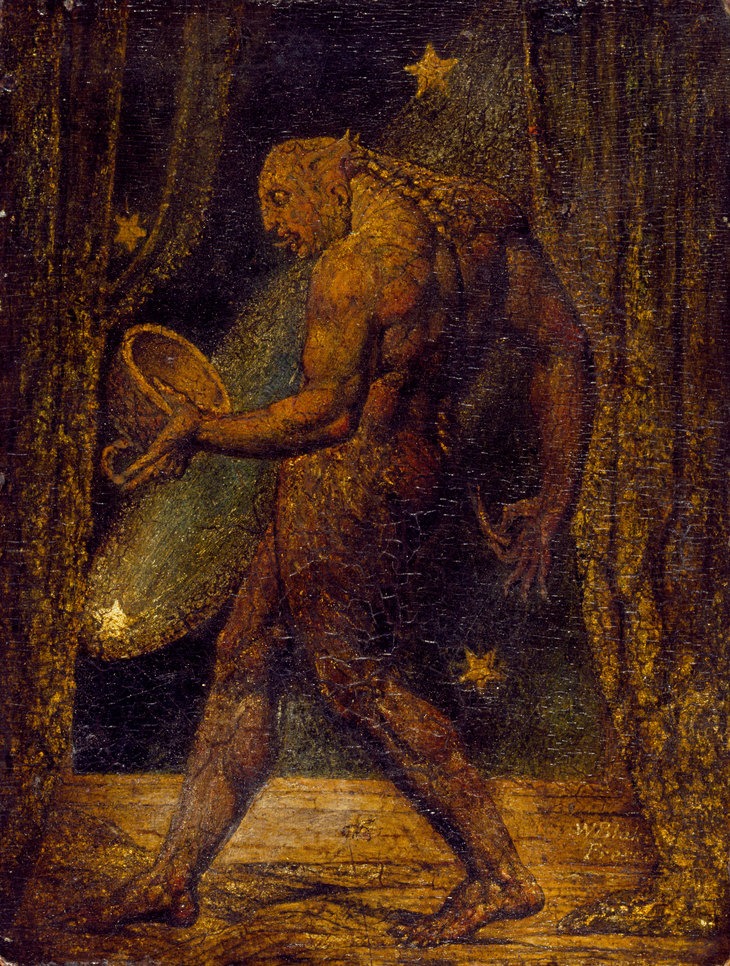
Other highlights include Newton (which you may recognise as the direct inspiration for Eduardo Paolozzi's Newton statue outside the British Library) and Ghost of a Flea, which was inspired by a séance-induced vision.
Ghost of a Flea
The exhibition culminates with The Ancient of Days 1827, a frontispiece for an edition of Europe: A Prophecy, completed only days before Blake's death.
Europe
Elsewhere, William Blake: The Artist focuses on London, the city in which he was born, and whose burgeoning metropolis was a constant inspiration. Another inspiration was Blake's wife, Catherine, who offered both practical assistance and became an unacknowledged hand in the production of his engravings and illuminated books.
William Blake: The Artist is at Tate Britain from 11 September 2019-2 February 2020. Tickets £18 (£17 concessions) available now.


BLANCA ORAA MOYUA

Archivo del blog